The Issue Was Raised. The Risk Wasn't.
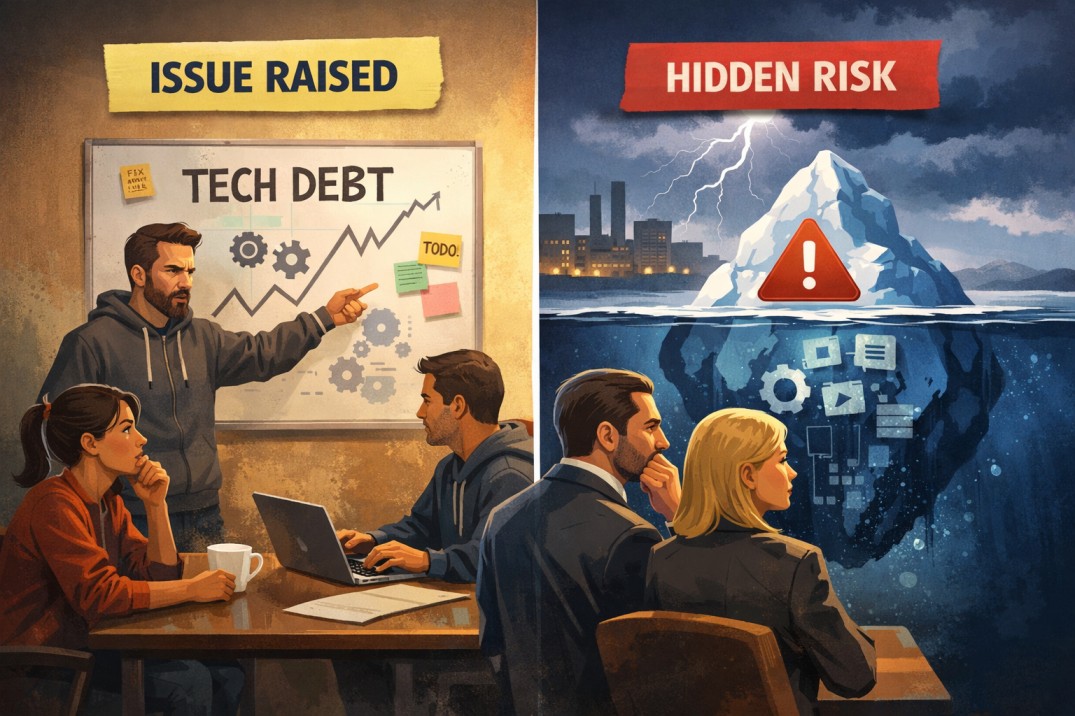
Most technical leads I’ve worked with are good at identifying problems. They spot risks early, understand how they compound, and make sure they’re raised. What they often miss is making that risk legible to the people who need to act on it, and taking responsibility for how it gets understood.
For a while, this doesn’t look like a problem. Delivery continues, features keep getting shipped, and nothing feels urgent enough to justify slowing things down. The system appears to hold.
Visibility vs Action
That gap is where projects usually get hurt. Not because the lead stayed silent, but because raising an issue and communicating its impact are two different things. Most leads do the first and assume they’ve done the second, even as they continue to align with decisions that push the problem out.
The vocabulary doesn’t help. “Tech debt” sounds like housekeeping, something the team wants time to tidy up. It doesn’t sound like a delivery risk, even when that’s exactly what it is. So the ask gets parked, the roadmap moves on, and the problem compounds quietly while attention stays on what’s immediately visible.
I saw this play out in one of the projects I was part of. The team had inherited a core module that was poorly written and fragile, sitting at the center of almost everything they shipped. They understood the gaps early and called it out. It came up in planning discussions more than once, got acknowledged, and was consistently deprioritised in favour of feature work that felt more pressing.
Each time it was raised, it was framed the way engineers naturally do, as “tech debt”, as something that needed cleanup, as a piece of the system that wasn’t in a best state. The concern was visible, but it never quite translated into something that demanded action. That lack of urgency got accepted. The lead chose to align with other priorities, instead of pushing and making the risk understood, and allowed the system to keep moving.
So the team kept building. New features landing on a foundation that wasn’t designed to hold them. The risk wasn’t visible in any single sprint, but it was accumulating underneath.
The Problem Becomes Visible
By the time the project reached hardening, the nature of the problem had changed. What had been framed as tech debt was now clearly a regression risk. Any meaningful change to that module carried a real chance of breaking things that were already signed off, with impact no longer limited to engineering effort, it was tied directly to timelines and delivery confidence.
The concern landed, but it landed in a very different context. It was no longer about code quality or cleanup. It was about whether the system could be trusted to hold under change, and what that meant for commitments already being made.
From the lead’s perspective, nothing was new. This had been raised multiple times, the problem hadn’t suddenly appeared, it had just become visible to everyone else. From the outside, though, it didn’t feel that way. The question in the room wasn’t just about the risk, it was about why this was becoming critical only now. And almost quietly, the conversation shifted from the system to the lead.
That’s where credibility erodes. Not because the lead didn’t raise the problem, but because the way it was communicated didn’t carry enough weight, and the lead didn’t take a stand to change decisions when it mattered. By the time the language was right, the timing was already wrong.
Framing Changes Everything
Nothing about the problem changed between those two conversations. Only how it was understood.
“Tech debt” keeps the conversation inside engineering. It signals imperfection, not danger. It tells people the system isn’t clean, not that it might not hold under change. The same problem, framed differently, lands in a completely different place. That reframing isn’t a communication trick, it’s the lead’s job.
Costs stay within the team. Risks travel. Once the consequence becomes visible on its own, the conversation has already moved on from whether to act, it’s now about who missed it.
The real miss rarely happens during hardening. It happens much earlier, where something important is raised, acknowledged, and then allowed to sit.
Raising the issue isn’t what changes things. Making it impossible to ignore does.